
If you’ve ever looked up your property online, you’ve probably seen those neat boundary lines drawn around your lot. At first glance, they look official. However, when you compare two different map sites, the lines often don’t match. That’s usually the moment when homeowners realize something important — online maps don’t equal legal boundaries. This is exactly where a local surveyor steps in. Instead of trusting one screen view, they combine Minneapolis city records, Hennepin County map data, subdivision plats, and field measurements. In other words, they build the answer from multiple layers of proof.
Why Online Property Maps Create So Much Confusion
Online parcel maps feel precise because they show clean shapes and labeled lots. Still, those lines come from generalized GIS data, not fresh field surveys. Because of that, they work best for reference, not decisions.
For example, aerial images can shift slightly over time. Data layers can also come from different record sets. As a result, the line you see may sit a few feet away from the legal boundary. That difference might not matter for browsing — but it matters a lot when you plan a fence or addition.
A local surveyor knows this gap exists. Therefore, they treat online maps as clues, not conclusions.
How a Local Surveyor Starts With the Property’s Record Story
Before anyone visits the site, real boundary work begins with research. A local surveyor first pulls the parcel number and legal description. Then they reviewed the subdivision plat and recorded the lot layout. This step reveals how the lot was originally created and measured.
Minneapolis has many older neighborhoods with layered history. Some lots were adjusted, split, or re-platted over time. Because of that, two homes on the same block can follow different record logic even if they look similar on today’s maps.
This record-first approach gives direction to everything that follows. It also prevents wasted field time and wrong assumptions.
How Minneapolis Property Records Add Important Context
City property records often show more than owners expect. They include permit history and improvement data tied to the address. While these records don’t define the boundary, they often reveal pressure points near it.
For instance, a permit may show a garage built close to a rear line. Another record might show a side-yard addition or a large patio near a neighbor’s edge. These details alert a local surveyor to areas that need extra attention during measurement.
Because of that, record review helps shape the survey plan before boots ever hit the ground.
Why Plat Maps Still Drive Boundary Logic Today
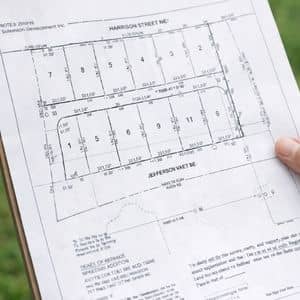
Subdivision plat maps remain one of the strongest boundary references available. They show the original lot dimensions, angles, and curve details recorded when the land was first divided.
Unlike modern parcel viewers, plats connect directly to measured survey data. A local surveyor reads these maps to understand how each lot fits within the block and how the boundary math should work.
This step often surprises homeowners. Many assume modern digital maps replaced older plats. In reality, surveyors still rely on those original documents every day because they carry legal weight.
How Hennepin Control Points Support Accurate Measurement
Hennepin County maintains survey control and monument data across the region. These points act like anchors in the wider measurement network. However, they don’t automatically mark your property corners.
Instead, a local surveyor uses them as trusted reference positions. From there, they measure outward using plat dimensions and record bearings to locate your actual boundary corners.
This method creates a dependable measurement chain. It also explains why professional boundary work takes more than finding a random metal pin in the ground.
Why Easements Change How Boundaries Function
Ownership and use don’t always match perfectly. Recorded easements often grant limited rights across part of a property. Utility paths, access strips, and drainage corridors appear frequently in Minneapolis records.
Online maps rarely show these clearly. Still, a local surveyor checks them early because they affect what you can build and where. You may own the land, yet certain improvements must stay clear.
Understanding that difference protects homeowners from design errors and permits trouble later.
How Map Research Connects to Field Proof
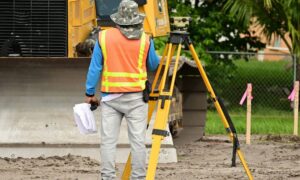
After the desk research phase, field verification turns records into real-world positions. A local surveyor looks for physical evidence such as corner markers and occupation lines. Then they measure distances and angles based on plat data.
Sometimes the physical evidence fits the record perfectly. Other times it conflicts. When conflicts appear, the surveyor weighs all available evidence and resolves the boundary using professional standards.
This careful comparison produces the final boundary position — not the online map line.
Why Certain Minneapolis Projects Need More Than Map Review
Some projects raise the stakes quickly. Fence replacements, garage rebuilds, side additions, and lot line adjustments all depend on accurate boundaries. Title transfers and refinance surveys also require reliable location proof.
In these cases, guessing from map overlays creates risk. A local surveyor removes that guesswork and replaces it with measured certainty.
That clarity protects both your project and your investment.
Why Working With a Local Surveyor Makes a Real Difference
Local experience improves boundary work more than most people realize. Minneapolis neighborhoods show different plat styles, monument patterns, and record quirks. A surveyor who works locally recognizes these patterns faster and solves problems more efficiently.
Maps provide direction. Records provide structure. Field measurement provides proof. When a local surveyor connects all three, you get answers you can trust — not just lines on a screen.
And when property decisions carry cost and consequence, trusted answers matter most.